
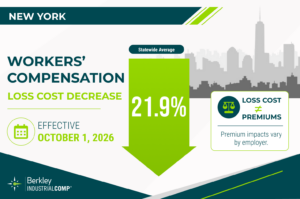
New York employers may see changes to their workers’ compensation pricing beginning this fall. The New York State Department of Financial Services has approved a workers’ compensation loss cost filing that includes an overall 21.9% decrease in statewide loss costs, effective for policies written or renewed on or after October 1, 2026.
While this is positive news for many employers, it is important to understand what the filing means and what it does not mean for an individual policy.
What Was Approved?
The filing includes:
- A 22.7% decrease in the average manual loss cost level
- No change to the provisions for terrorism, natural disasters, and catastrophic industrial accidents
- An overall statewide loss cost change of -21.9%
Loss costs are a foundational component of workers’ compensation pricing. They reflect the expected cost of workplace injury claims and related expenses for each classification of work.
The approved changes apply to policies effective on or after October 1, 2026, including eligible new business and renewal policies.
What is Driving the Change
According to the filing, the decrease reflects several favorable trends within New York’s workers’ compensation system, including:
Favorable loss experience
Recent policy-year experience contributed to a lower overall loss cost indication.
Lower loss adjustment expense provisions
Updated data supported a reduction in the provision for expenses associated with handling claims.
Continued improvement in claim trends
The filing cites favorable claim frequency and long-term severity trends. Combined with projected wage trends, the selected net trend factor was a significant contributor to the overall reduction.
Benefit-level changes partially offset the decrease
Increases to New York’s maximum and minimum weekly workers’ compensation benefits added upward pressure to the filing. However, the favorable loss and claim trends more than offset that impact.
The Change Will Vary by Class
The statewide figures are averages and do not represent a uniform change for every business or industry.
Each workers’ compensation classification code has its own loss experience and corresponding loss cost. As a result, some classifications may see decreases greater than the statewide average, while others may experience smaller decreases—or, in some cases, increases.
That variation is an important part of the actuarial process. It helps ensure that loss costs continue to reflect the current experience and risk characteristics of each type of work.
A Lower Cost Does Not Automatically Mean a Lower Premium
This is the most important takeaway for employers.
A loss cost is not the same as an insurance rate or final premium. Carriers use approved loss costs as a starting point and then apply their own approved loss cost multiplier (LCM) and other policy-specific rating factors.
The actual premium impact for a business may be affected by factors including:
- Classification-specific loss cost changes
- The carrier’s loss cost multiplier
- Experience modification factor
- Schedule rating adjustments or scheduled modifications, where applicable
- Payroll changes
- Claims history and loss experience
- Credits, debits, minimum premium requirements, and other carrier-specific underwriting considerations
For that reason, employers should not assume that a 21.9% statewide loss cost decrease will result in a 21.9% premium reduction, or any specific premium reduction, for their own policy.
What Employers Should Do
With the new loss costs taking effect October 1, 2026, employers should review upcoming renewal projections with their broker or insurance carrier. A policy-specific review can help identify how the revised class-code loss costs and other rating variables may affect the renewal premium.
The filing is an encouraging indicator of continued favorable workers’ compensation experience in New York. However, the ultimate impact will depend on each employer’s operations, classifications, payroll, claims experience, and insurer pricing structure.
For questions about how these changes may affect your organization’s workers’ compensation renewal, contact your insurance professional.
Berkley Industrial Comp is providing this material for informational purposes only; it does not constitute legal advice or professional consulting services. Berkley Industrial Comp makes no representations or warranty regarding the accuracy or completeness of this material and expressly disclaims any liability for errors, omissions, or inaccuracies. Employers and other recipients should seek independent legal advice before making decisions based on this material.